
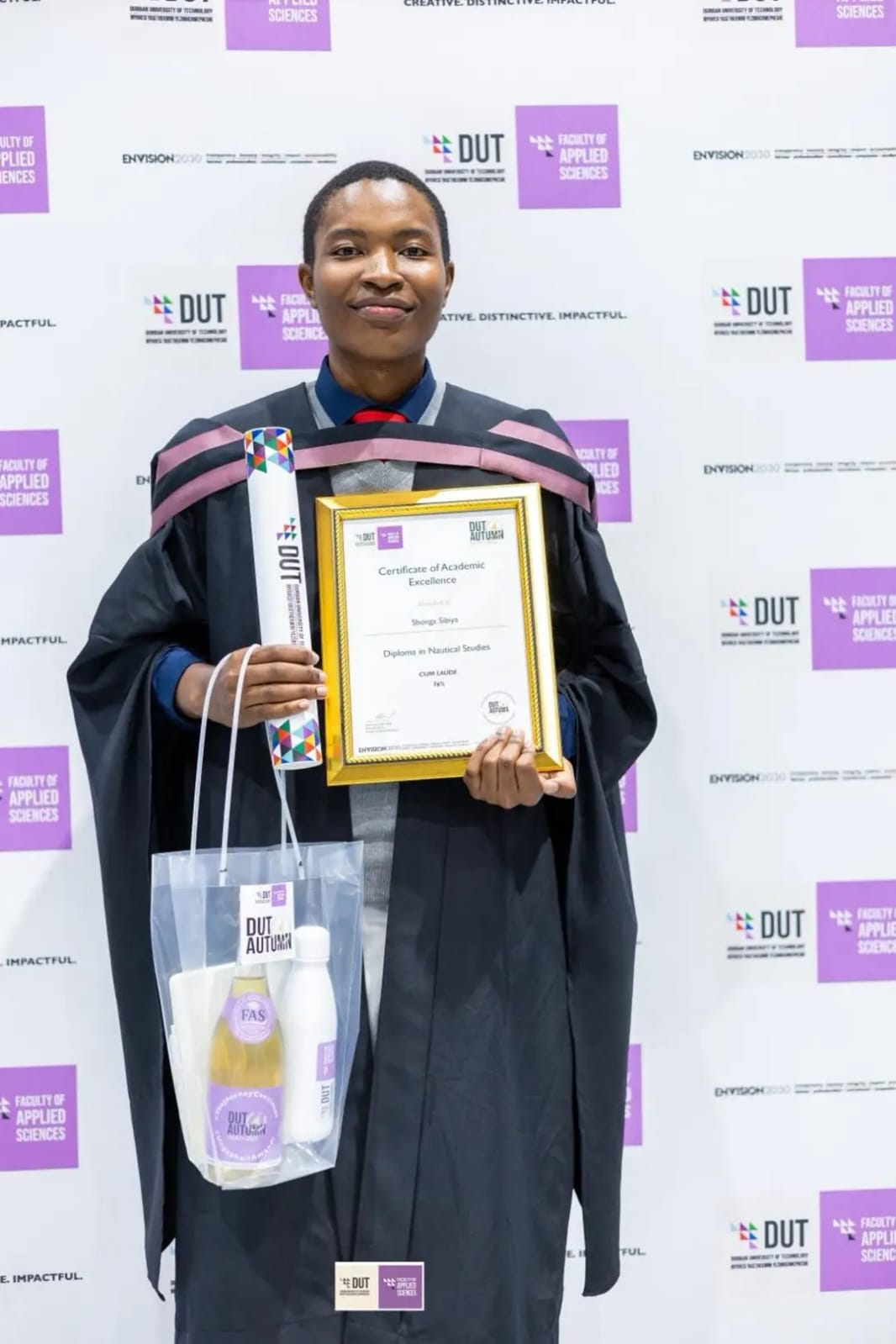
“This qualification helped me gain theoretical, practical knowledge, and skills that I will need when I go on board to work safely and efficiently on the ship,” says Nautical Science graduate, Sbonga Sibiya.
Sibiya, (21), from the township of Inanda, West of Durban, is proof that dreams can thrive regardless of one’s circumstances.
Sibiya recently graduated from the Durban University of Technology with a Diploma in Nautical Studies, achieving the distinction of cum laude.
The 21-year-old from Inanda developed an interest in Nautical Studies while in matric in 2022 after his friend, Shamir Rampersadh, introduced him to careers at sea which sparked his passion for the maritime industry. Rampersadh also introduced him to sailing, a sport that quickly became another passion where Sibiya was introduced to the Sail Africa Youth Development Foundation, an organisation that empowers young people through sailing initiatives.
Speaking to the eThekwini Maritime Cluster (EMC), Sibiya said that obtaining this qualification has enhanced his competence in key areas of the maritime profession, including navigation, ship stability and cargo operations.
“It provided a foundation for me to begin my professional journey as a cadet and continue developing through sea time experience, oral exams and certifications of competence. It’s an important step towards becoming a competent seafarer and eventually progressing into senior positions like an officer,” said Sibiya.
Providing further insights into the field of Nautical Studies entails, he shared on what the course is about and what can be gained when studying towards it.
“It’s based on the operation, navigation, and management of ships. It consists of modules like navigation, meteorology, ship stability, shipboard management, and operations. It prepares us for work at sea by developing our technical and operational skills needed to safely and efficiently navigate ships.”
“At the Durban University of Technology, we participated in practical training that included navigation simulations, chartwork, bridge watchkeeping exercises, and passage planning. These practicals helped me develop decision-making, problem solving, teamwork, and situational awareness skills. We were able to apply classroom knowledge in realistic ship scenarios which helped prepare for the responsibilities and challenges of working on board a vessel,” he added.
He adds that his main goal is to gain sea-based experience after graduating and move up the ranks as a Deck Officer. Long-term, he aims to become a Master Mariner and contribute to the growth of South Africa’s maritime industry.